
 English
 Arabic
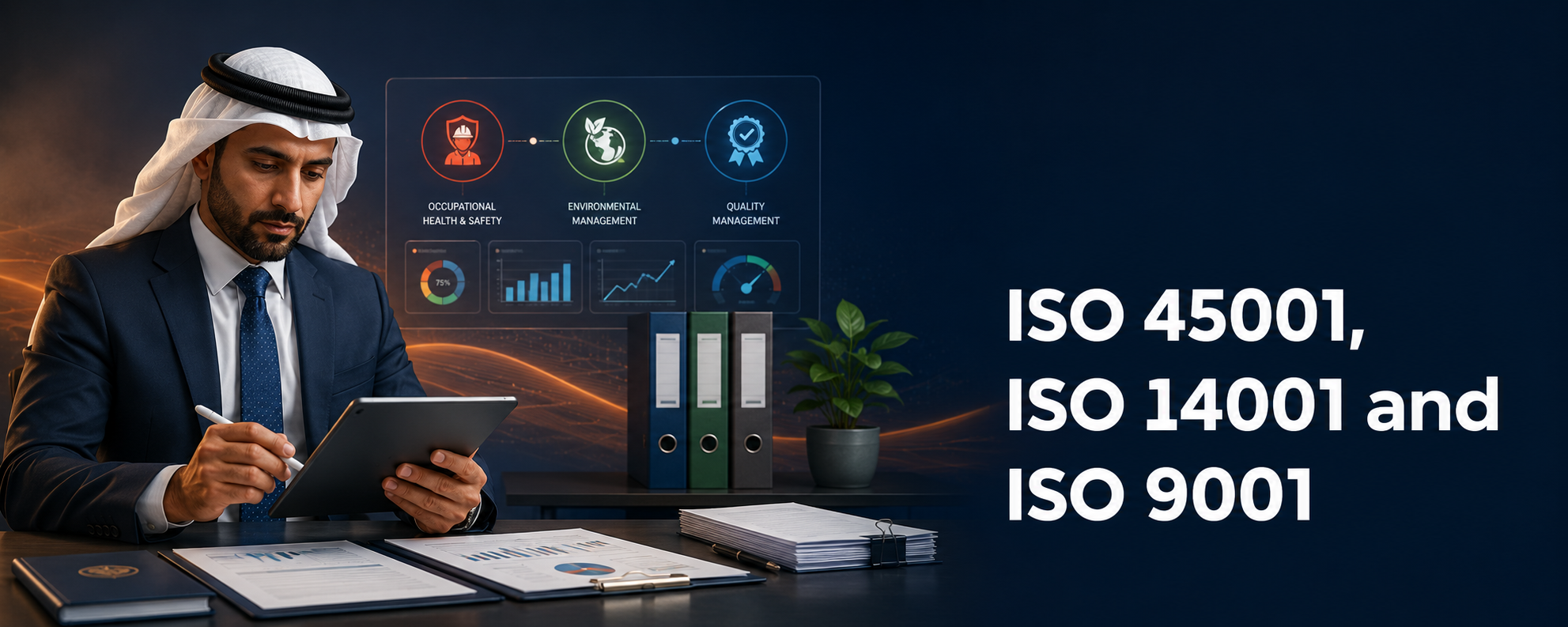
Integrated Management Systems: ISO 45001, ISO 14001 and ISO 9001
A 30–40 hour programme that builds the competence to design, audit, and maintain a genuinely integrated management system spanning quality, environmental, and occupational health and safety requirements — built for QHSE managers, IMS coordinators, internal auditors, and consultants across Saudi Arabia, the UAE, and the wider GCC.
Course starts in
Description
Programme Highlights
One System, Three Standards
Genuine Annex SL integration — merging the common clauses shared by ISO 9001, ISO 14001, and ISO 45001 into one coherent system, rather than maintaining three parallel silos that merely reference one another.
Integrated Audit & Documentation Efficiency
One audit programme, one document control system, and one management review cycle covering all three disciplines — cutting the duplicated effort of running quality, environmental, and OH&S systems separately.
Practical, Template-Based Workshop Output
Participants leave with an actual integrated process map, a combined IMS audit checklist, and a management-review agenda template — deployable tools, not just theoretical understanding.
Built for GCC Contractor & Certification-Body Expectations
Case studies reflect the combined ISO 9001/14001/45001 certification increasingly required in contractor prequalification across Saudi Arabia, the UAE, and Qatar, where certification bodies routinely conduct a single integrated audit visit.
Course Curriculum — 8 Modules
IMS Structure and Integration
Genuine integration begins with understanding exactly what the three standards already share, and this module builds that foundation. Annex SL — the common high-level structure adopted by ISO 9001:2015, ISO 14001:2015, and ISO 45001:2018 — is introduced as the technical enabler of integration: identical clause numbering across Clauses 4 to 10, and substantially common core text for requirements such as context, leadership, planning, competence, document control, internal audit, management review, and improvement. Participants learn to distinguish these genuinely common clauses, which can be merged into a single integrated procedure, from the standard-specific requirements — customer focus and product conformity under ISO 9001, environmental aspects and compliance obligations under ISO 14001, worker participation and hazard elimination under ISO 45001 — that still demand dedicated treatment within the integrated system. Integration benefits are quantified concretely: a single management review cycle instead of three, one internal audit programme instead of three parallel calendars, and one certification audit visit instead of three separate certification-body engagements — directly relevant to GCC organisations under pressure to reduce audit fatigue and duplicated documentation. The module closes on the most common integration failure: building three procedures that merely cross-reference each other rather than one genuinely unified system, and how to recognise the difference during a real IMS design review.
Context and Interested Parties
Clause 4's "context of the organisation" requirement is common to all three standards, and this module teaches it as one integrated exercise rather than three separate ones. Participants determine internal and external issues relevant to quality, environmental, and OH&S performance simultaneously — market conditions and customer expectations, environmental regulatory pressures and community concerns, and workforce composition and contractor safety culture, examined together rather than in isolation. Interested-party identification is mapped across all three domains at once: customers and regulators for quality, environmental authorities and surrounding communities for environmental performance, and workers, contractors, and labour authorities for OH&S — surfacing the interested parties, such as a major client or a national regulator, who have needs and expectations spanning more than one discipline. A single IMS scope statement is drafted, defining the boundaries within which the integrated system operates. The module's central deliverable is one integrated risks-and-opportunities assessment that deliberately captures interactions between the three domains — an environmental risk that is simultaneously a safety hazard, or a quality nonconformity with genuine safety implications — rather than three disconnected risk registers that miss precisely these cross-domain interactions.
Integrated Policy and Objectives
A single policy statement must satisfy three distinct sets of policy content requirements without diluting any one of them, and this module builds that drafting skill directly. Participants work through the specific commitments each standard requires — customer satisfaction and continual improvement under ISO 9001, environmental protection and pollution prevention under ISO 14001, and hazard elimination and worker participation under ISO 45001 — and practise integrating them into one coherent policy statement that top management can genuinely stand behind, rather than a generic combined statement that satisfies none of the three in real depth. Measurable objectives are then set within one integrated planning framework: discipline-specific targets (a quality defect-rate objective, an environmental waste-reduction target, an OH&S incident-rate target) that remain distinct and genuinely measurable rather than merged into vague combined metrics that cannot actually be audited. The module closes on accountability structure — assigning clear ownership of quality objectives, environmental objectives, and safety objectives within one IMS governance framework, so that integration does not accidentally blur who is responsible for delivering each discipline's results.
Process Approach and Controls
The process approach and PDCA cycle sit at the heart of all three standards, and this module applies them once across the integrated system rather than three times in parallel. Participants map an organisation's operational processes a single time, then learn to layer three distinct control types onto each process step: risk controls (OH&S hazard controls applied through the hierarchy of control), environmental controls (aspects-and-impacts controls and pollution-prevention measures), and quality controls (process and product conformity checks). This single-map, multi-layer technique directly avoids the common failure of maintaining three separate flowcharts for what is, in reality, one physical operation. Realistic GCC process examples are used throughout — a construction site concrete pour, a manufacturing production line, an oil and gas maintenance shutdown — showing how the same operational step carries a quality control point, an environmental control point, and a safety control point simultaneously. This module's process map becomes the direct working foundation for the hands-on deliverable built in Module 08.
Integrated Documentation
Documentation is where integration either genuinely takes hold or quietly fails, and this module builds a working IMS documentation architecture. Participants design a single IMS manual structure housing the procedures that are genuinely common under Annex SL — document control, internal audit, management review, corrective action — alongside the discipline-specific procedures and registers that must remain distinct: a risk register for OH&S, an environmental aspects-and-impacts register, and a nonconformity register capturing findings across all three disciplines in one traceable log. Document control practices are addressed for a single integrated system — versioning, approval routing, and distribution control that spans all three disciplines rather than three parallel document-control processes. Record retention receives particular attention, since retention periods can legitimately differ by discipline and by applicable regulatory requirement — incident investigation records, for instance, often warranting longer retention under OH&S regulatory expectations than routine quality inspection records — and the module teaches how to build one retention schedule that correctly reflects these differences rather than applying a single blanket retention period that under-protects one discipline or over-retains another.
Integrated Audit Planning
Running three separate audit calendars defeats the purpose of integration, and this module builds a genuinely single audit programme covering all three standards. Participants plan one integrated internal audit programme rather than three parallel schedules, sequencing audits so that common-clause elements are reviewed once per cycle rather than three times. Combined audit checklists are built to walk through shared Annex SL clauses first, then branch cleanly into discipline-specific lines of enquiry for quality, environmental, and OH&S requirements — a structure that keeps the audit efficient without skipping discipline-specific depth. Sampling strategy for an integrated audit receives dedicated treatment: selecting a representative sample of processes, records, and site areas that gives genuine assurance across all three disciplines within a single site visit, rather than three separate visits each sampling in isolation. Auditor competence is addressed directly and honestly — an individual auditor conducting an integrated audit needs working knowledge across all three disciplines, or the audit team itself must be composed to cover any competence gap, referencing the CQI-IRCA auditor competency framework that governs how certification bodies and organisations assess this requirement in practice.
Management Review and KPIs
Management review is the point where leadership genuinely engages with the IMS, or where it quietly becomes a rubber-stamp meeting — and this module builds the single-agenda approach that keeps it meaningful. Participants design one management review agenda that satisfies the input requirements of all three standards in a single meeting: customer feedback and quality KPIs, environmental compliance status and performance data, incident statistics and OH&S performance, internal and external audit results, corrective action status, and a revisit of the risks-and-opportunities assessment from Module 02. Integrated KPI selection is addressed practically — choosing indicators that give leadership a genuine single-page view across all three disciplines rather than a fragmented report requiring three separate briefings. The module closes on converting management review outputs into tracked improvement actions with clear ownership and timelines, closing the loop from the objectives set in Module 03 through to demonstrated performance and continual improvement — the evidence a certification body or contractor prequalification panel will look for as proof the IMS is operating as a living system rather than a paper exercise.
IMS Implementation Workshop
The capstone workshop converts seven modules of learning into three tangible, immediately usable deliverables. Working against a realistic case-study organisation modelled on a GCC construction, manufacturing, or energy-sector operation, participants build an integrated process map showing precisely where quality, environmental, and safety controls intersect on real operational steps — applying the layered-control technique from Module 04. They then construct a combined IMS audit checklist, structured with shared Annex SL clause questions first and discipline-specific branches following, ready for immediate use in a genuine integrated internal audit. Finally, participants draft a management-review agenda template that satisfies all three standards' input requirements within a single meeting structure, synthesising the KPI and reporting approach built in Module 07. The workshop is deliberately hands-on and output-focused: participants leave not with notes about how integration works in theory, but with three working templates they can adapt and deploy directly within their own organisation's IMS.
Software, Standards & Platforms
Course Outcome
On completing this course, you will be able to design a genuinely integrated management system spanning ISO 9001, ISO 14001, and ISO 45001, build one integrated process map and audit programme instead of three parallel ones, grade findings and run a single management review across all three disciplines — core competencies for QHSE manager, IMS coordinator, internal auditor, and consultant roles across Saudi Arabia, the UAE, and the wider GCC.