
 English
 Arabic
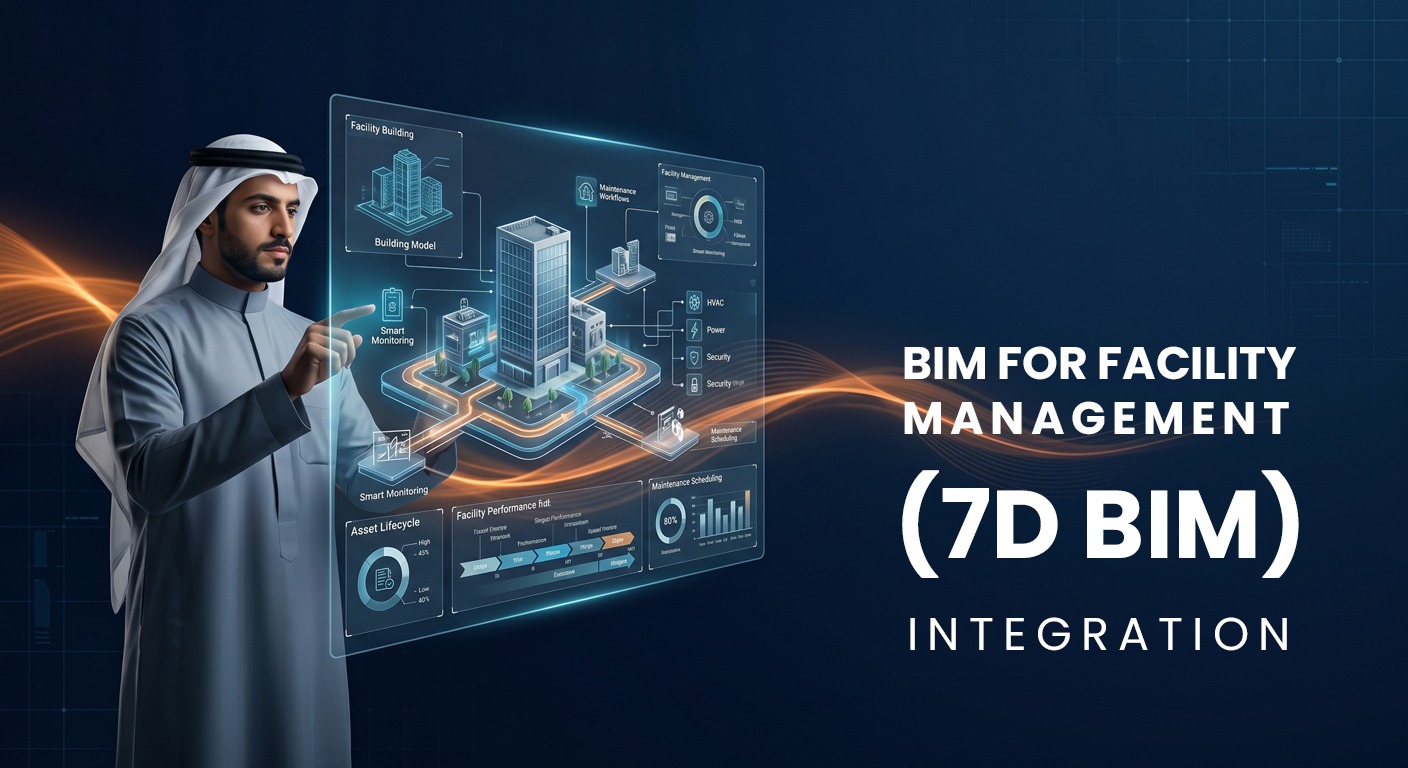
BIM for Facility Management (7D BIM) Integration
From BIM fundamentals to full facility lifecycle management — structured for MEP engineers, BIM coordinators, and AEC professionals across the GCC.
Description
BIM for Facility Management builds a structured understanding of how Building Information Modeling applies across the full asset lifecycle — from design and construction through to operations and maintenance. The course is specifically structured for professionals working in MEP engineering, BIM coordination, and facility management, and positions each concept within the GCC project environment where 7D BIM adoption is accelerating across government, infrastructure, and commercial sectors.
Module Breakdown
BIM Fundamentals — What BIM Is and Why It Matters
Understand what Building Information Modeling is, how it differs from traditional CAD workflows, and why the shift to BIM is now a professional requirement across the Middle East construction market. Participants establish the vocabulary and conceptual foundation needed to engage with every subsequent module — covering the intelligence embedded in a model, the data it carries, and the value it delivers across design, construction, and operations.
What is BIM — Process, Technology, and Methodology
A structured breakdown of BIM as a data-driven process. Understand the intelligence embedded in the 3D model and how it supports design decisions, MEP coordination, and facility handover across the project lifecycle. This module distinguishes BIM as a methodology from BIM as a technology — establishing why data quality, model authoring discipline, and information management are the foundations of every successful BIM-enabled project in the GCC.
BIM Strategy — Planning and Deploying BIM Across Projects
How organizations plan and adopt BIM at a project and portfolio level. Covers BIM execution planning, information delivery strategy, and alignment with regional mandates in the UAE, Saudi Arabia, and Qatar. Participants learn how to evaluate organizational BIM readiness, define information requirements, and structure a BIM Execution Plan (BEP) that positions MEP teams and BIM coordinators for effective delivery from project inception.
BIM Framework — Information Requirements and Delivery Stages
The structural layers governing BIM implementation: Level of Development (LOD), information requirements, data exchange protocols, and delivery stages that define how BIM data is produced and managed on live projects. This module covers Employer Information Requirements (EIR), Asset Information Requirements (AIR), and the relationship between project information models and asset information models — the information architecture that makes 7D BIM operationally viable for facility management teams.
BIM Uses — Applications Across Design, Construction, and Operations
A practical taxonomy of BIM use cases — from design coordination and clash detection through to facility management, MEP systems tracking, and asset lifecycle management. Understand which use cases apply to your role, and how different BIM applications connect across the project delivery chain from design consultants to MEP subcontractors to FM operators on major GCC infrastructure and real estate development programmes.
BIM Workflow — Internal and External Information Flows
How information moves between design teams, MEP engineers, contractors, and facility managers. Understand the data handover requirements that make 7D BIM functional in live building operations and maintenance workflows. Covers Common Data Environments (CDE), information container management, revision control, and the structured handover sequence that bridges construction completion and FM activation — the critical last mile of a BIM-enabled project in the GCC.
Project Team Roles & Responsibilities — Who Does What in a BIM-Enabled Project
Covers BIM Manager, BIM Coordinator, Information Manager, and discipline lead responsibilities across the project lifecycle. Understand team structures for MEP BIM, structural BIM, and facility management delivery — including how these roles interact on large-scale GCC infrastructure contracts, who owns information at each stage, and how accountability is maintained from design through to post-occupancy asset management.
Open BIM — Interoperability, IFC, and Open Data Standards
Standards-based BIM using IFC, BCF, and open data formats. Understand how Open BIM enables multi-vendor workflows, reduces software dependency, and supports long-term facility management data integrity across asset portfolios. Covers IFC schema, COBie relationships, and how Open BIM protocols align with ISO 19650 to deliver interoperable, maintainable building data that remains accessible and useful across the full operational lifespan of a facility — from handover through to decommissioning.
Course Outcome
A structured command of BIM — from fundamentals to 7D facility management
On completing this course, you will have a structured command of BIM fundamentals, strategy, and workflow — with a clear understanding of how 7D BIM applies to facility management, MEP operations, and asset lifecycle management. These competencies are directly applicable to BIM Coordinator, Facility BIM Manager, MEP BIM Engineer, and VDC roles across the GCC construction and infrastructure sector.
Explain the BIM framework, information requirements, and delivery stages on GCC construction contracts.
Apply BIM strategy and BIM Execution Planning principles to MEP and facility management project environments.
Manage information workflows across design, construction, and FM handover using Common Data Environment principles.
Understand Open BIM protocols including IFC, BCF, and COBie, and apply them to long-term asset information management.
Perform effectively in BIM Coordinator, Facility BIM Manager, MEP BIM Engineer, and VDC roles on live GCC projects.