
 English
 Arabic
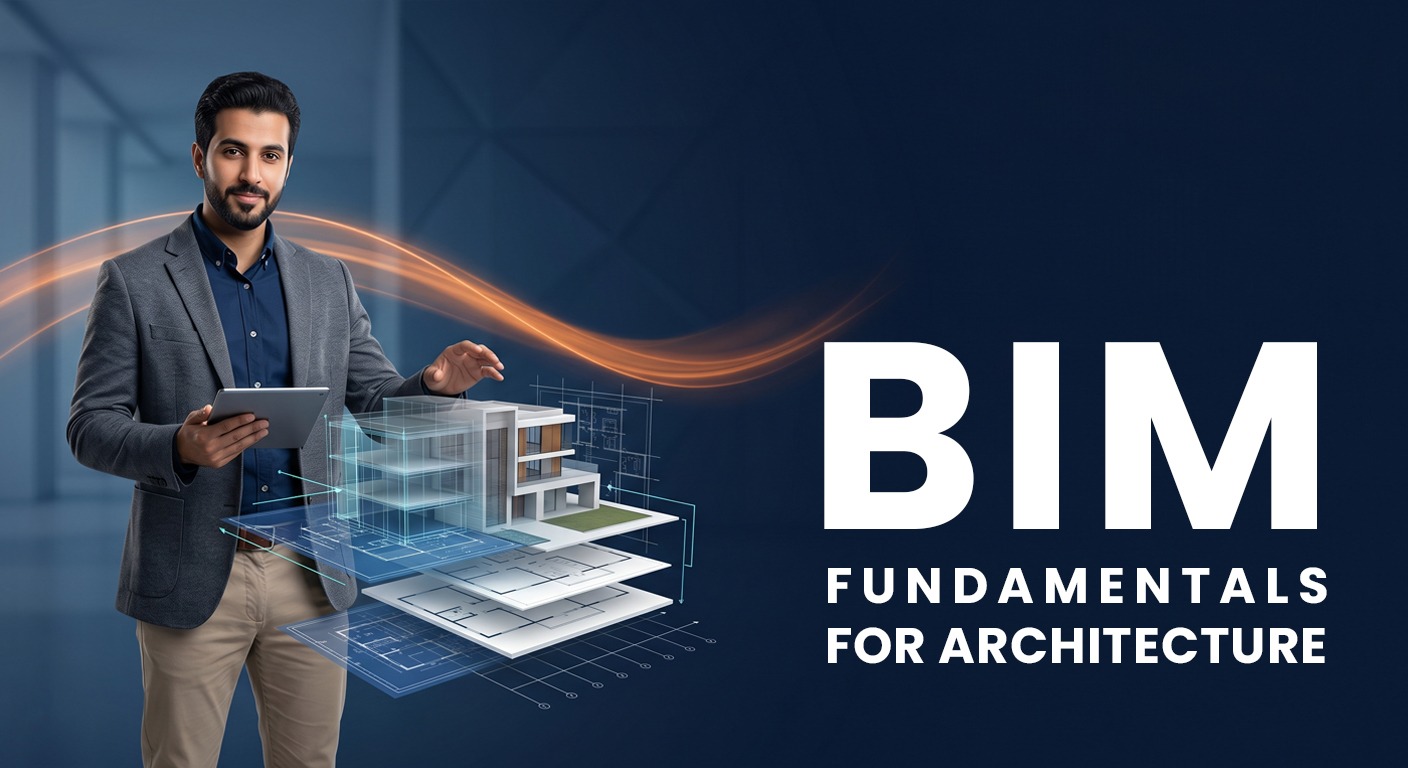
BIM Fundamentals for Architecture
A progressive, eight-module programme covering the complete entry-level BIM landscape for architecture — from core concepts and GCC industry context through hands-on Revit, Navisworks, and ArchiCAD workflows, international standards, LOD frameworks, multidimensional BIM, and emerging technologies — building the knowledge and software exposure needed to enter professional BIM practice across the Middle East.
Description
Programme Highlights
Three Industry-Standard Platforms
Gain direct hands-on exposure to Autodesk Revit for architectural BIM authoring, Navisworks Manage for model coordination and clash detection, and ArchiCAD as the leading alternative BIM platform in architectural practice — covering the software landscape that GCC employers and project environments actually use.
GCC-Aligned Standards — ISO 19650 and BEP
Study the international BIM standards that underpin government, infrastructure, and major private sector projects across Saudi Arabia, UAE, and Qatar — including ISO 19650, BIM Execution Plan requirements, and Common Data Environment protocols that are increasingly mandatory for GCC project tender submissions.
Full LOD Framework — Concept to Handover
Understand Level of Development requirements from LOD 100 through LOD 500 — covering how model detail obligations change across design, procurement, construction, and asset management phases and how to produce BIM deliverables that align with contractual and client expectations at each project stage.
Multidimensional BIM — 4D, 5D, and Beyond
Extend beyond 3D modeling into schedule-linked 4D simulation and 5D cost integration — understanding how quantity takeoff, cost data, sustainability analysis, and facilities management information connect to the BIM model across the full project lifecycle from design through asset operation.
Course Curriculum — 8 Modules
BIM Concepts and Industry Context
Establish a clear, accurate understanding of what Building Information Modeling is — and what it is not. This module moves beyond the common misconceptions that confuse BIM with 3D modeling or software proficiency, establishing the correct definition: BIM as a process of creating and managing building information across the project lifecycle, with software as the enabling tool rather than the definition. Participants learn how BIM differs from traditional CAD-based design and documentation workflows — examining the information management, coordination, and decision-support capabilities that BIM introduces and that CAD cannot replicate. The module maps current BIM adoption across the GCC construction market: the government mandates in Saudi Arabia under MOMRA and the National BIM Program, UAE authority requirements for permit submissions in Dubai and Abu Dhabi, and Qatar's infrastructure programme BIM requirements — giving learners a clear picture of where BIM is mandatory, where it is becoming expected, and what roles BIM professionals occupy in architecture firms, engineering consultancies, main contractors, and project management organisations across the region.
Autodesk Revit for Architecture
Develop foundational proficiency in Autodesk Revit — the primary BIM authoring platform for architecture across the GCC construction market — through direct, hands-on work with the tools used in professional architectural practice. This module introduces the Revit interface and project environment, covering the parametric modeling logic that distinguishes Revit from CAD, the view-model relationship that makes simultaneous plan, section, and elevation coordination possible, and the project template and browser structure that organises large-scale architectural models. Participants work with core architectural modeling tools — walls, floors, roofs, doors, windows, stairs, and railings — and develop an understanding of Revit families: the parametric component library system that underpins all model objects and drives schedule and documentation outputs. The module establishes the link between model elements and drawing production, covering view configuration, detail level settings, and the sheet setup workflow that connects 3D model data to professional construction documentation outputs aligned with GCC architectural practice.
Navisworks for Coordination
Develop practical exposure to Autodesk Navisworks Manage — the industry-standard platform for multi-discipline model coordination and the tool that BIM coordinators use to combine, review, and clash-check federated project models on GCC construction projects. This module introduces the Navisworks workflow from an architecture perspective: how Revit models are exported as NWC files and combined with structural and MEP discipline models into a single federated model, how the Selection Tree and search sets are used to organise multi-discipline model elements for coordination, and how Clash Detective is configured to identify spatial conflicts between architectural, structural, and MEP components before they become site issues. Participants run basic clash tests, review results, and understand the formal clash report output. The module also introduces TimeLiner for 4D construction simulation — covering how model elements are linked to project schedule activities to produce the time-sequenced construction visualisations used for stakeholder communication and programme validation on GCC project delivery programmes.
ArchiCAD BIM Authoring
Develop working knowledge of ArchiCAD — Graphisoft's BIM authoring platform — as the leading alternative to Revit in architectural practice and one of the two primary BIM tools encountered in architecture firms, project management consultancies, and government client organisations across the GCC and internationally. This module covers the ArchiCAD interface and project environment, the tool logic and modeling approach that distinguishes it from Revit, core architectural modeling tools including walls, slabs, roofs, and openings, and the ArchiCAD family and object library system. Participants develop an understanding of how ArchiCAD projects are structured, how views and layouts work for documentation production, and how ArchiCAD models are exported to IFC and other interchange formats for coordination with Navisworks and structural and MEP discipline models. The module positions learners to work within ArchiCAD-based project environments and to contribute to teams that use ArchiCAD as their primary BIM authoring platform — a skill profile that significantly broadens employability across GCC and international architectural practice.
BIM Standards and Execution
Understand the international standards and execution frameworks that define how BIM is governed, delivered, and verified on major projects across the GCC and internationally. This module covers the ISO 19650 series — the global standard for managing information over the whole lifecycle of a built asset — examining its requirements for appointed parties, information delivery obligations, and the appointment and exchange information requirements that must be addressed in pre- and post-appointment BIM Execution Plans. Participants study BIM Execution Plan structure and content: scope definition, LOD schedules, model criteria, team responsibilities, CDE protocols, and the technical appendices that constitute a complete BEP document. The module covers Common Data Environment requirements — container states, naming conventions, revision control, and exchange event workflows — and addresses the interoperability standards (IFC, BCF, COBie) that enable BIM data to flow between different software platforms. The practical GCC context is addressed throughout: how these standards apply to Saudi Arabia's National BIM Program requirements, UAE authority BIM submission mandates, and Qatar infrastructure programme delivery obligations.
Levels of Development
Develop a thorough understanding of the Level of Development (LOD) framework — the industry standard language for communicating what a BIM model element represents, how much information it contains, and what it can reliably be used for at each project stage. This module covers the full LOD spectrum from LOD 100 (conceptual massing) through LOD 200 (approximate geometry), LOD 300 (accurate design model geometry), LOD 350 (construction model with connection and interface information), LOD 400 (fabrication-level detail), and LOD 500 (as-built record model for handover and facilities management). Participants learn to interpret LOD requirements in BIM Execution Plans and employer information requirements — understanding what geometric and non-geometric data obligations apply to architectural, structural, and MEP elements at each stage. The module addresses how LOD schedules are used to define BIM delivery milestones in GCC project contracts, how to check model compliance against LOD specifications, and how LOD 500 handover obligations connect BIM delivery to the facilities management and asset register requirements of GCC government and institutional clients.
4D, 5D, and Beyond
Extend the BIM learning journey beyond 3D model creation into the multidimensional applications that make BIM a project management and lifecycle intelligence tool rather than a documentation platform. This module covers 4D BIM: how model elements are linked to construction programme activities to create time-sequenced construction simulations that validate sequence logic, support tender and progress reporting, and communicate construction phasing to stakeholders — a deliverable increasingly required on Saudi Vision 2030 infrastructure programmes, UAE megaprojects, and Qatari public sector developments. Participants then explore 5D BIM: how quantity takeoff data is extracted directly from coordinated BIM models to support cost planning, bill of quantities preparation, and procurement workflows — understanding the connection between model element parameters, quantity schedules, and cost estimate outputs. The module also introduces 6D sustainability analysis — using BIM model data for energy performance simulation and green building certification support — and 7D facilities management, where the BIM model becomes the operational information system for asset maintenance, space management, and lifecycle cost tracking across GCC government and institutional building portfolios.
AI, Automation, and VR in BIM
Develop awareness of the emerging technologies that are actively reshaping design, construction, and project delivery workflows across the AEC industry globally and in the Middle East — positioning learners to engage with the digital transformation agenda that GCC government clients, major developers, and international contractors are advancing on programmes like NEOM, Qiddiya, and the UAE's smart infrastructure pipeline. This module covers AI-driven design automation: how generative design tools and machine learning applications are being integrated into BIM workflows to accelerate option generation, optimise building performance, and support code compliance checking at design stages that traditionally required extensive manual work. Parametric modeling concepts are introduced — covering how parametric relationships between model elements enable rapid design iteration and data-driven form generation that are increasingly applied on complex GCC architectural projects. The module also covers virtual reality integration with BIM: how Revit and ArchiCAD models are exported to VR platforms for immersive client presentations, stakeholder walkthroughs, and design review sessions — a communication technique now standard practice among leading architecture firms and developers operating in the GCC market.
Software, Standards & Platforms
Course Outcome
On completing this programme, you will have the knowledge, software exposure, and workflow understanding to operate as a contributing BIM professional on architecture and construction projects. You will be prepared to apply for BIM coordinator, BIM modeler, and Revit technician roles in the UAE, Saudi Arabia, Qatar, and across the GCC — and to continue development toward BIM management and project leadership positions in architecture firms, engineering consultancies, main contractors, and project management organisations across the Middle East.